
Our Locations
Kitchener
Email For Us
info@kwicphysiotherapy.com
Save you from pain
548 889 3432
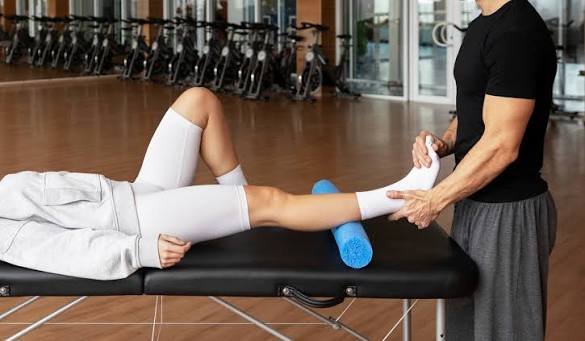
If you train in Kitchener, Waterloo, Cambridge, Guelph, or anywhere in the KW region, I need to say this plainly: most gym injuries are not bad luck. They usually come from repeatable mistakes — too much load too soon, sloppy technique, and pretending pain is part of being serious. I see it every week in clinic. Someone pushes hard for three weeks, ignores warning signs, then wonders why a shoulder, knee, or low back has started complaining.
As a physiotherapist, my job is not to make you timid. My job is to keep you training. If you want to stay strong without breaking down, manage the basics: workload, movement quality, recovery, and the boring little details that protect you.
Physiotherapy helps prevent gym injuries by finding the patterns that make you prone to overload before they turn into pain. I assess how you squat, hinge, press, pull, breathe, brace, and recover, then match that to your training plan. If your ankle mobility is limited, your knees may cave in during squats. If your upper back is stiff, your shoulders may take over during pressing. If your load jumps too fast, your tissues may not keep up.
That is the real value of physiotherapy in Kitchener-Waterloo: not just treating pain after the fact, but spotting the cracks early. I can help you change your warm-up, adjust exercise selection, modify volume, and build capacity where you are weak.
Here are the habits that frustrate me most, because they are so preventable.
Resistance training is valuable, but it is not risk-free. Aasa et al. (2017) reported that injury rates in weightlifters and powerlifters vary, but injuries do happen, especially when training is rushed or poorly supervised. The shoulder, lower back, and knee are common problem areas because they absorb a lot of force under fatigue.
That is why I keep coming back to workload management. Gabbett’s 2016 work on the Acute:Chronic Workload Ratio made an important point: when your recent training load spikes far above what your body has been prepared for, injury risk rises. In plain English, a sudden jump in sets, sessions, or intensity is where trouble starts.
I do not use ACWR as a magic number. I use it as a reminder that progression should look like adaptation, not chaos. If you live in Kitchener, Waterloo, Cambridge, or Guelph and want to train long term, stop chasing random heroic weeks. Build steadily.
Here is a real example from clinic. A guy in his early thirties came in from Waterloo after adding 40 pounds to his deadlift over about three weeks because a new program told him to. He felt unstoppable — right up until his lower back seized on a Monday morning and he could barely get off the couch. Nothing was torn. He had simply outrun his own recovery. We backed the load off, cleaned up his bracing and hip hinge, and rebuilt his volume over the next month. Within six weeks he was pulling more than his old best, and this time it held. That is the pattern I see constantly: the injury was not the deadlift itself, it was how fast he got there. Patience is not the opposite of progress — it is what makes progress stick.
A proper warm-up should prepare you for your session, not just raise your heart rate. I like a simple structure: raise, mobilize, activate, and potentiate. That means a short pulse-raiser, specific mobility work, activation for stabilizers, and a few graded ramp-up sets before the main lifts.
If you are heading into squats, deadlifts, overhead pressing, or Olympic lifting variations, this matters. A warm-up is not a formality. It is part of injury prevention.
People often ask me about the Functional Movement Screen. My answer is always the same: FMS can be useful as part of a bigger assessment, but it should never be treated like a perfect injury-prediction test. The validity research is mixed, and reviews question how well a score alone can forecast who gets hurt.
That is exactly how I use screening in clinic. I do not rely on one score and declare you safe or unsafe. I look at the whole picture: history of injury, training age, current load, mobility, control, asymmetry, and how you actually move under pressure.
When someone comes in from Kitchener, Waterloo, Cambridge, or the wider KW region, I want to know where the system is breaking down. A few things matter immediately.
From there, I build the plan around capacity. That may mean tempo work, isometrics, better deloads, exercise swaps, or a smarter progression model.
If you want the blunt version, here it is: train like someone who plans to be lifting in ten years.
If you train in the KW region and keep running into the same ache, do not just wait it out and hope. Persistent problems usually have a mechanical or load-related cause.
I work with people who train for strength, aesthetics, sport, and general health. The common thread is this: they want to keep moving. Physiotherapy connects the dots between your symptoms and your training. In a place like Kitchener-Waterloo, where commuting, desk work, family life, and training all compete for time, that connection matters.
If you are in Waterloo after work, lifting in Cambridge on weekends, or fitting sessions around a busy life in Guelph, your program has to be realistic. The best plan is the one you can recover from and repeat.
Book a physiotherapy assessment if you have recurring pain, a recent training jump, poor movement confidence, or a history of the same injury coming back. You do not need to be broken before you get help. In fact, the earlier we intervene, the easier it usually is to fix the problem.
KWIC Physiotherapy in Kitchener can help you train smarter, reduce injury risk, and keep your gym routine moving forward.
Yes. Physiotherapy helps by identifying movement faults, training errors, and capacity deficits before they become injuries. I can adjust your exercise selection, load progression, mobility work, and warm-up so you stay ahead of pain.
You do not need to wait for a major injury. If you have recurring tightness, poor recovery, or a history of the same issue returning, a preventive assessment can help.
General muscle soreness can be normal, especially after a new stimulus. Sharp pain, joint pain, or pain that changes your technique is not something to ignore.
If your sets, frequency, intensity, or total volume jumped sharply in a week or two, that is a red flag. Gabbett’s workload research supports the idea that sudden spikes can increase injury risk.
Not always, but you should not keep pushing blindly either. Some problems need load modification, exercise changes, or short-term rest. A physiotherapist can help you decide what is safe.
It can help a lot. I can assess ankle motion, hip control, trunk stability, and barbell mechanics, then give you drills and cues to improve the lift.
FMS can be a useful screening tool, but its predictive validity is limited when used alone. I treat it as one piece of the assessment, not the whole answer.
The biggest mistake is loading too aggressively without enough preparation. Most injuries I see involve too much too soon, combined with poor movement quality or poor recovery.
If you want help training safely in Kitchener, Waterloo, Cambridge, Guelph, or anywhere in the KW region, book with KWIC Physiotherapy Kitchener. I will help you find the problem, fix the mechanics, and get you back to training with confidence.
Gurpreet Kaur, DO — Osteopathic Manual Practitioner
Musculoskeletal Assessment | Combination Care | Manual Osteopathy
Gurpreet Kaur is an osteopathic manual practitioner at KWIC Physiotherapy in Kitchener, focused on whole-body movement assessment and musculoskeletal conditions. She regularly collaborates with the physiotherapy team to deliver combination care for active patients and gym-related injuries across Waterloo Region.
Abhay Mehta, PT — Registered Physiotherapist
Shoulder | Sports Rehabilitation | Concussion
Abhay Mehta brings shoulder-certified expertise and sports rehabilitation experience to KWIC’s multidisciplinary team, working with active patients from Kitchener, Waterloo, Cambridge, and Guelph who want to train harder without breaking down.
Aaditya Shastri, PT — Registered Physiotherapist & Co-Owner
Acupuncture | Orthopaedic Physiotherapy | Sports
Aaditya Shastri is a co-owner and physiotherapist at KWIC Physiotherapy, holding full acupuncture certification. He integrates acupuncture and manual therapy to support recovery and performance optimization for athletes and gym-goers in Kitchener-Waterloo.




[…] Preventing Gym Injuries in Kitchener-Waterloo: A Guide […]